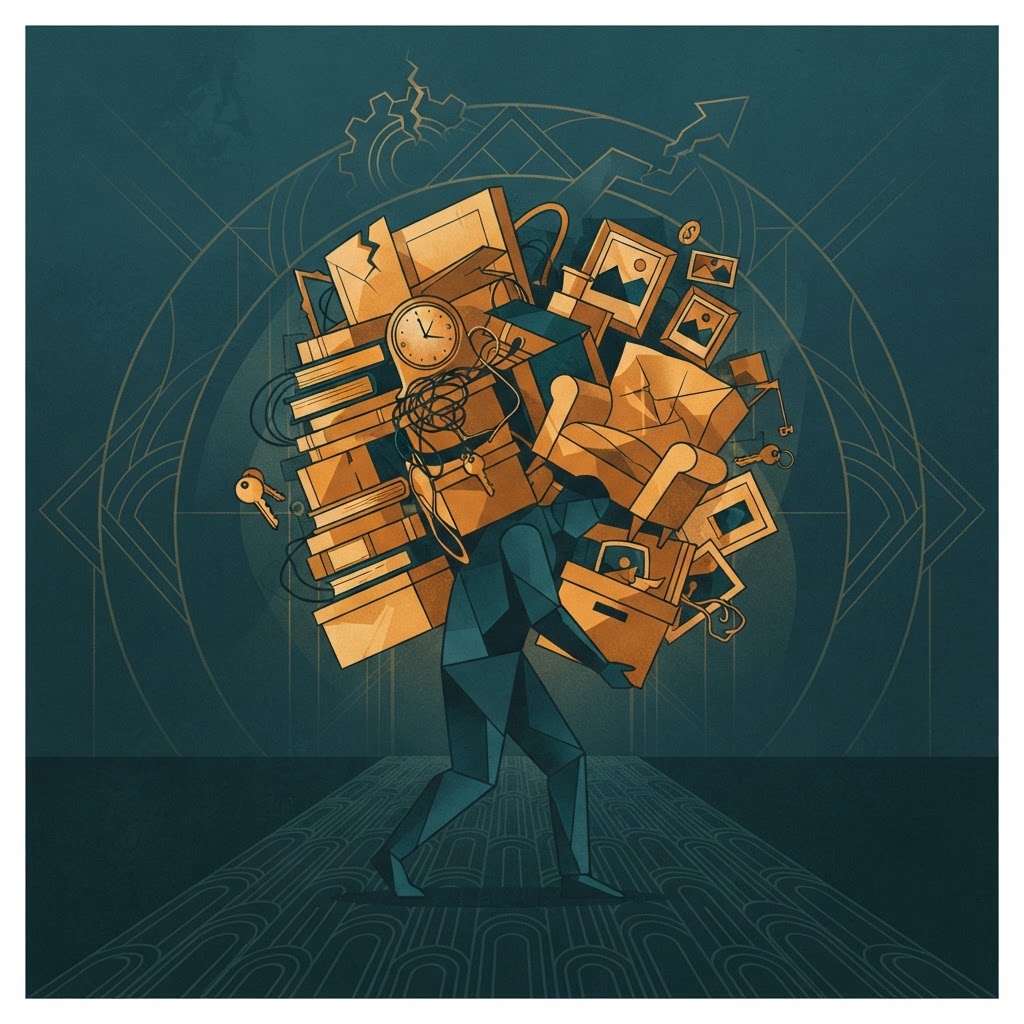

Look around your immediate environment. Is there a pile of mail perched on the entryway table, an unread stack of books on your nightstand, or a closet stuffed with garments that haven’t seen daylight since 2018? For most of us, excess belongings rarely register as an active choice. Instead, possessions seem to multiply through a slow, silent accretion. Yet each stray mug, receipt, and sentimental relic exerts a tangible cognitive toll.
Far from a simple character flaw or lack of domestic discipline, the mess around us reflects deep-seated evolutionary shortcuts, neurobiology, and identity defense. When we struggle to tidy our environments, we are not just wrestling with objects; we are navigating decision fatigue, neural associations, and the psychological boundaries of who we believe ourselves to be.
The Brain on Clutter: Attention, Cortisol, and Cognitive Overload
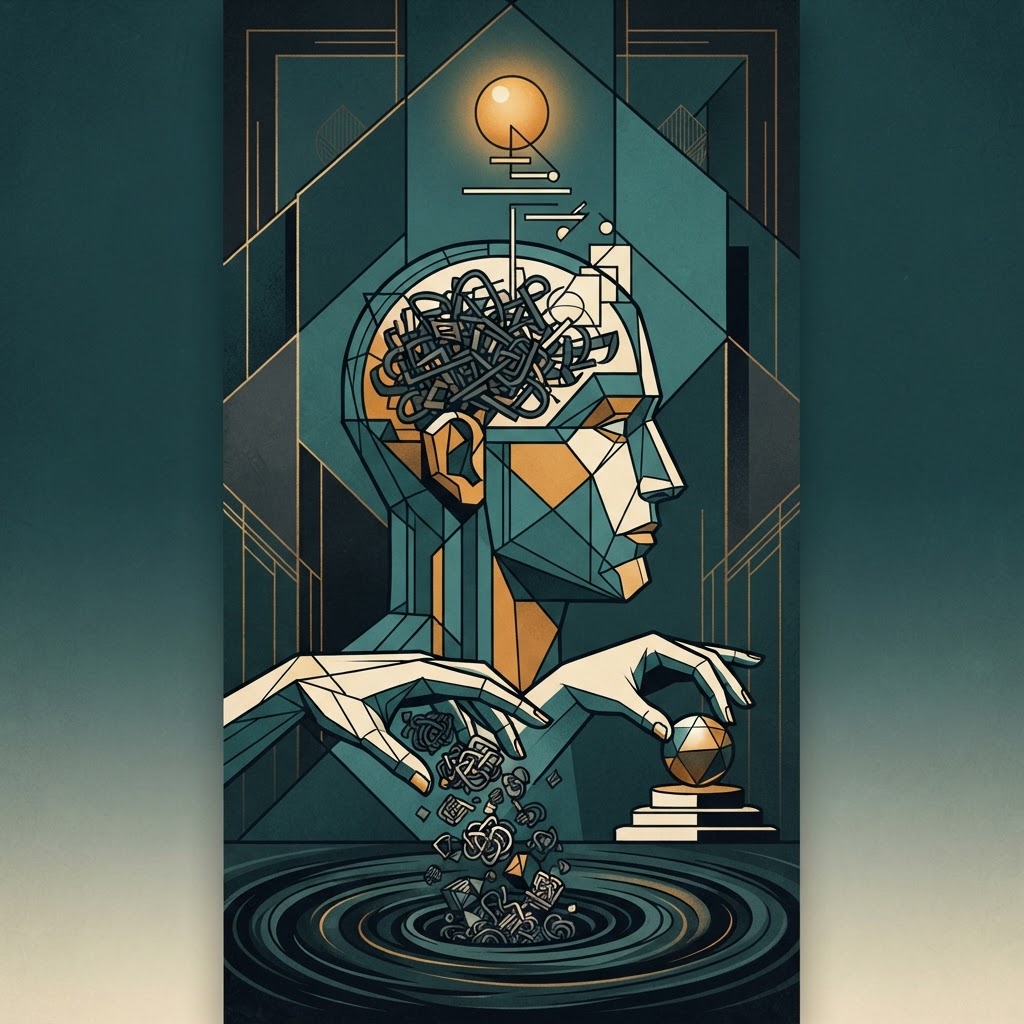
Our visual field is constantly competing for neural representation. When your desk is strewn with stray pens, half-filled notebooks, and charging cables, each item registers as a visual stimulus demanding sensory processing. Researchers at Princeton University discovered that physical disorganization restricts cognitive capacity by competing for attentional resources in the visual cortex [2]. Simply put, clutter splits your focus, decreasing working memory and limiting your ability to process information efficiently.
This visual competition doesn’t merely dampen productivity—it fundamentally alters your physiological state. Studies have shown that sustained physical clutter correlates directly with elevated levels of cortisol, the human body’s primary stress hormone [1]. A chaotic home environment prevents the nervous system from fully downregulating into rest-and-digest mode. Instead of signaling safety and sanctuary, a crowded room acts as a persistent sensory reminder of unfinished business, triggering the Zeigarnik effect—the psychological tendency for uncompleted tasks to intrude on conscious thought [1].
The "Extended Self" and Why Letting Go Feels Like Grief
If physical mess is biologically taxing, why is it so excruciating to purge? The answer often lies in consumer psychologist Russell Belk’s landmark concept of the "extended self" [9]. Human beings do not view their belongings strictly as external tools; we psychologically incorporate meaningful objects into our self-concept. A beat-up concert ticket or a chipped ceramic mug inherited from a grandparent is not merely cardboard or fired clay—it functions as a tangible anchor for personal identity and autobiographical memory [3, 9].
Neuroimaging studies reveal that this emotional bond is physiological. When individuals reflect on items they consider central to their identity, brain imaging shows heightened activity in the medial prefrontal cortex—the exact neurological region responsible for self-referential thought and identity processing [9]. Furthermore, memory consolidation mediated by the hippocampus and emotional intensity driven by the amygdala work in concert, tagging specific physical items with intense emotional significance [9]. Discarding that item can feel less like cleaning house and more like amputating a piece of one’s own lived history.
"Our belongings become woven into how we understand our own identity, almost like a second skin made of objects rather than tissue." [9]
The Paralysis of Decision Fatigue and Chronic Avoidance
Even when objects hold no deep emotional significance, accumulation persists due to a subtler cognitive hurdle: decision fatigue. Every single possession in your living space requires an active verdict. Do you keep it? Where does it belong? Does it need repairing? What if you need it someday [10]? Each micro-evaluation depletes your executive function, leaving you drained and prone to avoidance [1, 8].
Dr. Joseph Ferrari, a leading psychologist at DePaul University who studies the intersection of possessions and chronic procrastination, has demonstrated that clutter and behavioral procrastination are inextricably linked [4, 5]. In research assessing living environments, Ferrari and his colleagues found that clutter in personal spaces serves as a primary predictor of chronic procrastination and significantly lowers overall life satisfaction [4, 5]. When faced with the sheer cognitive burden of processing hundreds of decisions at once, our brains default to the path of least resistance: postponement [8]. The pile stays where it is, and the mental load compounds.
The Trap of the Tactile: Why Modern Advice Can Backfire
Popular tidying methodologies often advise people to hold every possession in their hands to evaluate whether it brings positive emotion. However, cognitive research suggests this tactic can inadvertently make decluttering harder. Consumer psychologists have long documented the "endowment effect"—our tendency to place significantly higher value on things merely because we own them, amplified by tactile contact [5, 9].
As Dr. Ferrari notes, simply touching an item increases psychological ownership and makes letting go markedly more difficult [5]. Retail environments deliberately exploit this dynamic by placing products at eye level to invite touch; when tidying up, handling every item can deepen emotional attachment rather than resolve it [5].
Reclaiming Mental Bandwidth: Evidence-Based Strategies
Transforming your relationship with your belongings requires addressing the cognitive friction that caused the buildup in the first place. Consider these psychologically sound approaches:
- Reduce the friction of decisions: Instead of sorting through an entire room, target one drawer, shelf, or single category of items at a time to sidestep decision fatigue [8].
- Shift from organizing to eliminating: Many people purchase storage containers to neatly hide excess possessions, only preserving the underlying cognitive burden. As organizational specialists observe, your primary instinct should be to discard rather than reshuffle [10].
- Decouple memories from physical matter: Create a digital archive by photographing sentimental artifacts or creating a dedicated, bounded "memory box" limited to a handful of core keepsakes [7, 8]. The memory resides in your neural pathways, not within the physical atoms of the object [9].
- Beware the touch instinct: When triaging neutral items or unneeded paperwork, evaluate items visually whenever possible to prevent tactile attachment from inflating their perceived value [5].
Our homes are intended to serve as restoration centers for overstimulated minds. By understanding the neurological hooks of sentimentality, the visual toll of sensory friction, and the biology of decision fatigue, we can dismantle the invisible weight of clutter—making room for cognitive clarity, presence, and genuine peace of mind.
Sources
- Rocky Mountain College of Art + Design – The Psychology of Clutter: Designing Organized and Stress-Free Spaces
- Juujbox – Why We Keep Stuff: The Psychology of Clutter
- Verywell Mind – What the Sentimental Items You Keep Say About You
- Springer Current Psychology – Procrastinators and Clutter: An Ecological View of Living with Excessive “Stuff”
- American Psychological Association – Why clutter stresses us out, with Dn. Joseph Ferrari, PhD
- Psychology Today – 5 Reasons Why Clutter Is Bad for Your Mental Health
- Becoming Minimalist – 7 Signs Your Sentimental Items Are Weighing You Down
- StorWise Self Storage – The Psychology of Clutter: Why We Hold Onto Things and How to Let Go
- NeuroLaunch – Psychology of Sentimental Items: Why We Cherish Objects and Their Emotional Impact
- Psychology Today – A Secret to Happiness? Don't Get Organized.