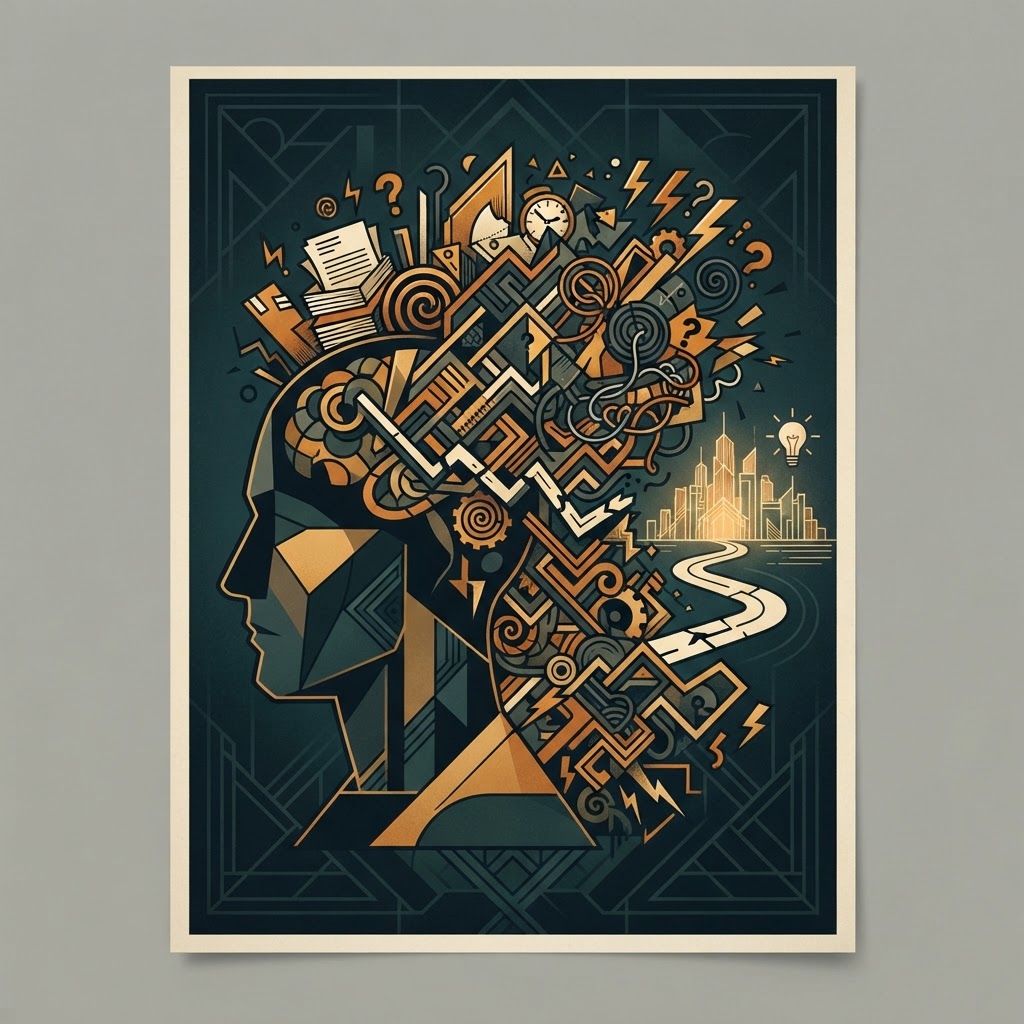

The Silent Weight of Your Surroundings
We have all been there: staring at a pile of unfiled documents or a kitchen counter buried under miscellaneous items, feeling a strange, heavy sense of inertia. You know you should clean it, yet you find yourself scrolling through your phone instead. While it is easy to label this as simple laziness, the reality is far more complex. The psychology behind clutter reveals that our physical environment acts as a constant, low-level drain on our cognitive resources, often leading to what researchers call decision loop paralysis [1].
The Brain on Clutter: Why It Exhausts You
Clutter is not just an aesthetic issue; it is a psychological one. According to Dr. Joseph Ferrari, a leading expert on the psychology of clutter and chronic procrastination at DePaul University, our physical environment is deeply linked to our emotional well-being [2]. Research indicates that excessive clutter can lead to increased stress, anxiety, and even symptoms of depression [2].
When your brain is surrounded by visual noise, it struggles to filter out irrelevant stimuli. This increases your cognitive load—the amount of mental effort being used in your working memory [8]. Just as excessive animations and text on a presentation slide can reduce audience comprehension by up to 35%, the clutter in your home or office forces your brain to work harder to focus on the task at hand [8].
The Anatomy of Decision Loop Paralysis
Why does clutter make us freeze? Finnish neuroscientist Dr. Aino Mäkinen describes a phenomenon known as “decision loop paralysis” [1]. When you look at a cluttered space, your brain attempts to process every item as a potential decision: Do I keep this? Where does this go? Should I throw this away? [1].
When faced with too many options at once, the brain becomes overwhelmed and effectively shuts down [1]. This is not a failure of willpower; it is a biological response to cognitive overload. Because our cognitive capacity is limited, our brains naturally prioritize tasks to conserve energy [10]. When your environment is chaotic, your brain may choose to avoid the "clutter task" entirely to preserve mental resources for other, more urgent demands [10].
Moving Beyond the Guilt
Many people view their inability to tidy up as a moral failing, but experts like Timothy Pychyl of Carleton University suggest that procrastination—including the avoidance of cleaning—is actually an "emotion-centered coping strategy" [5]. We avoid the clutter because the act of cleaning triggers negative emotions like demoralization or the fear of not meeting our own high standards [1].
Evidence-Based Strategies to Reclaim Your Space
If you are feeling paralyzed by your environment, consider these research-backed approaches to break the cycle:
- The Micro-Task Method: Instead of tackling the entire room, resolve to complete one tiny task—like clearing a single drawer or straightening a counter—that takes only a few minutes [1]. This reduces the "decision loop" and builds momentum.
- Connect to Your Self-Concept: Research suggests that tasks connected to your core values or identity hold more "subjective value" [6]. Frame your decluttering not as a chore, but as an act of creating a space that reflects your goals and mental clarity.
- Accept Imperfection: Perfectionism often fuels the anxiety that keeps us from starting [1]. Give yourself permission to make progress rather than achieving a "perfect" result immediately.
By understanding that your brain is not "lazy" but rather overwhelmed, you can stop the cycle of self-devaluation and start making small, meaningful changes to your environment. Remember, the goal is not to achieve a magazine-perfect home, but to reduce the cognitive friction that stands between you and your best work.
Sources
- Why We Put Things Off – https://www.psychologytoday.com/us/blog/incompetence/202609/why-we-put-things-off
- Why clutter stresses us out, with Dn. Joseph Ferrari, PhD – https://www.apa.org/news/podcasts/speaking-of-psychology/clutter
- Inside the psychology of productivity – https://www.psychologicalscience.org/news/inside-the-psychology-of-productivity.html
- The psychological origins of procrastination – and how we can stop putting things off – https://theconversation.com/the-psychological-origins-of-procrastination-and-how-we-can-stop-putting-things-off-47905
- Paper Reveals Presentation Clutter's Brain Drain – https://www.nen.wfglobal.org/digest/research-paper-presentation-clutter-cognitive-load-409023
- Why We Procrastinate and How to Stop – https://www.psychologytoday.com/ie/blog/human-flourishing-101/202410/why-we-procrastinate-and-how-to-stop/amp